



January intake is the second time each year that UK universities start new courses. Yes, many UK universities offer it, mostly for master’s degrees, plus a smaller number of bachelor’s, top-up and foundation courses. Classes begin in January, about four months after the September start. If you want to begin in January 2027, most applications close between mid-November and mid-December 2026.
What does January intake mean?
An intake is the time of year when a university starts a new group of students on a course. January intake is the second one. Classes begin in January instead of September or October.
You may also see it called the winter intake or the spring intake. It all means the same thing: courses that start in January or early February.
UK universities build their year around September, so September is the main intake and January is the smaller one. That’s why there are fewer courses to pick from, and why the closing dates for international students come earlier than most people expect.
Do UK universities have a January intake?
Yes, many do. But not every university offers one, and a university that does may only open a handful of its courses.
Most January places are at master’s level. A smaller number of universities also start bachelor’s degrees, top-up degrees and foundation courses in January. Business, management, computing, accounting and finance, data science and hospitality come up most often.
The quickest check is the course page itself. If it lists a January start date, the course has a January intake. If it only shows September, it doesn’t.
How does the January intake work?
It follows the same path as September, only squeezed into a shorter window. This is the usual order.
- Applications open. Many universities start taking January applications in the summer or early autumn.
- A closing date passes. For international students it usually falls between mid-November and mid-December.
- You get a decision. An offer is either conditional (you still need to meet something, such as an English score or final results) or unconditional.
- You meet the conditions and pay a deposit. Universities set their own dates for this.
- The university issues your CAS. That’s the Confirmation of Acceptance for Studies, and you need it for your visa.
- You get your visa and travel. International students apply for the UK Student visa at this stage.
- Enrolment, then classes. Teaching usually starts in mid to late January.
A real example shows how fast it moves. The University of Westminster’s postgraduate timeline closes applications on 20 November 2026, makes its last international offers on 23 November, wants conditions met and the deposit paid by 11 December, takes its last CAS request from outside the UK on 18 December, and enrols students on 11 January 2027.
That is about eight weeks from closing date to enrolment. It’s why applying early matters even more in January than in September.
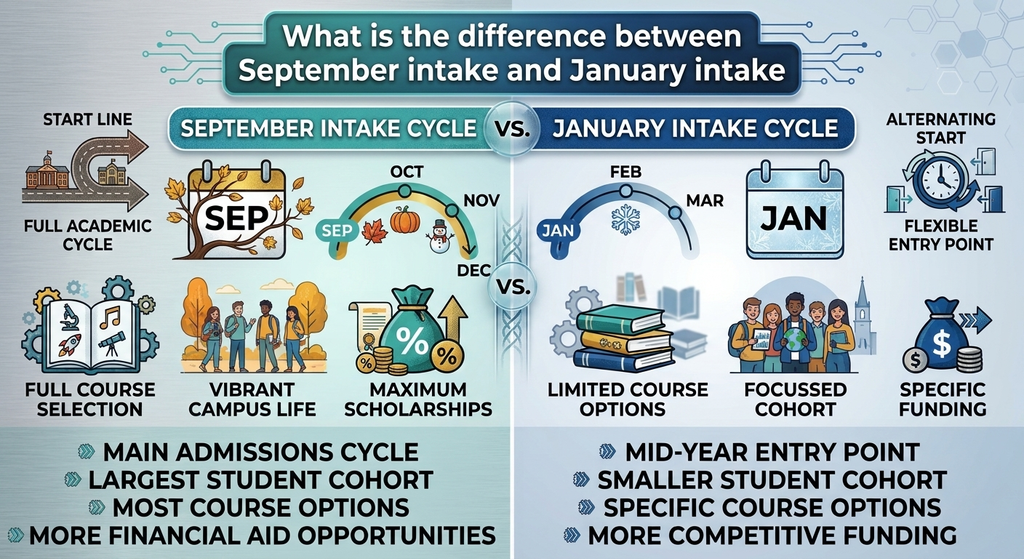
What is the difference between September intake and January intake?
Both lead to the same degree. What changes is the timing, the choice of courses and how you apply.
| September intake | January intake | |
|---|---|---|
| Also called | Autumn or fall intake | Winter or spring intake |
| Role | The main intake | The second, smaller intake |
| Classes start | September or October | Mid to late January, sometimes early February |
| Course choice | The widest, including most bachelor’s degrees | Narrower, and mostly master’s |
| Undergraduate applications | Through UCAS. The main deadline for 2027 entry is 13 January 2027 | Direct to the university for most international students |
| International closing dates | Many universities take applications until June | Mostly mid-November to mid-December |
| Scholarships | More choice | Fewer options |
| Competition | More applicants for each place | Usually fewer applicants |
Neither one is better. September gives you more choice and more time. January suits you if you missed September or need a few more months to get ready.
When to apply for January intake in the UK 2027
Apply now. It’s 13 November 2026, and most international closing dates fall between mid-November and mid-December. A few have already closed or close within days.
The best time to apply was September or October. If you’re past that point, this is what to do:
- Send applications in the next few days to universities that close in late November.
- Pick one or two that close in December as a back-up.
- Work back from the deposit and CAS dates, not only the closing date. They can come earlier.
One thing causes confusion. The UCAS deadline of 13 January 2027 is for courses that start in autumn 2027. It doesn’t apply to a January 2027 start.
We list published closing dates, university by university, in our guide to January intake UK 2027 deadlines, courses and how to apply.
Planning for January 2028 instead? Start in summer 2027. Shortlist courses and book your English test between June and August, then apply from September.
How to apply for January intake in the UK
The application is the same as for September. Most international students apply online on the university’s own website, one course at a time. Some undergraduate courses go through UCAS, so read the course page first.
Have these ready before you start:
- your certificates and transcripts
- your passport
- an English test result, or proof that you’re exempt
- a personal statement or statement of purpose
- your CV
- references, which master’s courses often ask for
- a portfolio or research proposal, if the course needs one
Three habits make a big difference:
- Apply to two or three universities. If one closes or fills up, you still have a place to go.
- Check the date for your own country. Some universities set different closing dates by nationality.
- Send everything at once. Missing documents slow down your decision, and January has no time to spare.
The visa rules, English test level and money you need to show are all in our January 2027 guide.
January intake universities in London
London has a good number of January starts, and most of them are at master’s level. These are the London universities with published January 2027 dates for international applicants, in date order.
| University | Closes (international) | Good to know |
|---|---|---|
| Brunel University of London | 13 November 2026 | Postgraduate. Includes MBA and international business courses. |
| University of Westminster | 20 November 2026 | Postgraduate. Enrolment on 11 January 2027. |
| University of East London | 27 November 2026 | Most January courses. Teaching starts 25 January 2027. |
| London Metropolitan University | 30 November 2026 | Dates can vary by nationality. Many courses start in January or February. |
| Kingston University London | 11 December 2026 | Standard January courses. Teaching starts 25 January 2027. |
| Queen Mary University of London | 14 December 2026 | Taught postgraduate. CAS request deadline is 11 January 2027. |
| Loughborough University London | 14 December 2026 | Master’s courses at the London campus. |
Royal Holloway, University of London runs a smaller group of master’s courses in January. Middlesex, Greenwich and Roehampton also list some undergraduate January starts, and the dates change from course to course.
Universities move these dates, so check the course page before you apply.
University January intake 2027 outside London
If you’re open to studying outside the capital, these January intake universities in the UK have published dates for international applicants.
| University | Closes (international) | Good to know |
|---|---|---|
| Cardiff Metropolitan University | 20 November 2026 | International applicants. |
| UWE Bristol | 27 November 2026 | |
| University of Kent | 27 November 2026 | Term starts 11 January 2027. |
| University of Lancashire | 30 November 2026 | |
| Northumbria University | 30 November 2026 | Postgraduate courses. |
| University of Northampton | 14 December 2026 | Undergraduate. Postgraduate closes 4 January 2027. |
The University of Liverpool, Coventry University and Birmingham City University also run January courses. Their dates change with the course and your country, so read each course page.
A university being on a list doesn’t mean every one of its courses takes January students. Check the exact course.
Is January the right intake for you?
It works well if:
- you missed the September deadlines
- you want to start in January instead of waiting for the next September
- your results, English test and documents are already in hand
Think twice if:
- you want the widest choice of courses
- you’re hoping for a big scholarship, because January has fewer
- your documents or funds aren’t ready, since the visa timeline is tight
- you want a bachelor’s degree, where the January list is shorter
Choosing September instead isn’t a failure. A calm, complete application usually beats a rushed one. If you need to build your grades first, our guide to foundation courses in the UK shows another way in.
Talk to Seemab Consultants in Manchester
Seemab Consultants Ltd is a UK-registered education consultancy in Manchester. More than 400 students have enrolled at UK universities with our help.
We run a free session every Wednesday at our office. Bring your certificates and we’ll check your eligibility on the spot. We also explain course options, Student Finance and how to apply, and every student gets one-to-one time with an advisor. Sessions run from 10:30 am to 12:30 pm and are limited to 30 students. The next ones are on 18 and 25 November and 2 December. They focus on foundation courses, so mention January when you meet your advisor.
Frequently asked questions
What does January intake mean?
January intake is the second time of year when UK universities start new courses. Classes begin in January or early February instead of September. It’s also called the winter or spring intake, and it is smaller than the main September intake.
Do UK universities have a January intake?
Yes, many do, but not all of them and not for every course. Most January places are at master’s level, with fewer bachelor’s, top-up and foundation courses. Check the course page for a January start date.
How does the January intake work?
You apply before the university’s closing date, get an offer, meet any conditions, pay a deposit and receive your CAS. Then you get your visa and arrive for enrolment in January. International closing dates usually fall between mid-November and mid-December.
How to apply for the January intake in the UK?
Apply on the university’s own website for the course you want, with your transcripts, passport, English test result, personal statement and CV. Some undergraduate courses use UCAS. Apply to two or three universities and send all your documents at once.
What is the difference between September intake and January intake?
September is the main intake, with the widest choice of courses and more scholarships. January is smaller, mostly at master’s level, and has a shorter application window. Both lead to the same degree.
When to apply for January intake in the UK 2027?
Now. As of 13 November 2026, most international closing dates fall between mid-November and mid-December, and some courses fill sooner. The best time was September or October, so send your applications within the next few days.
Which London universities have a January intake?
Brunel, Westminster, East London, London Metropolitan, Kingston, Queen Mary and Loughborough London all have published January 2027 dates. Royal Holloway, Middlesex, Greenwich and Roehampton also list some January courses.