


UK January Intake 2027 Can You Still Apply?
Yes, you can still apply for many UK courses that start in January 2027, but the window is closing fast. Most universities stop taking international applications between mid-November and mid-December 2026, and a few close within days. If you want a January start, pick your courses this week and get your documents ready now.
January 2027 at a glance
These are the questions students ask us first. The figures below are correct as of 9 November 2026, but always check the final date with your university.
| Question | Short answer |
|---|---|
| When do classes start? | January 2027. The exact date depends on the university. |
| When do applications close? | Mid-November to mid-December 2026 for most international applicants. Some courses close early if they fill up. |
| Where do I apply? | Directly to the university for most international students. Some undergraduate courses go through UCAS. |
| Which English test do I need for the visa? | A Home Office approved test (SELT) at CEFR B2 level for most new applicants. |
| How much money must I show? | £1,529 a month in London or £1,171 a month elsewhere, for up to 9 months. |
| When can I apply for the visa? | Up to 6 months before your course starts. Decisions from outside the UK usually take around 3 weeks. |
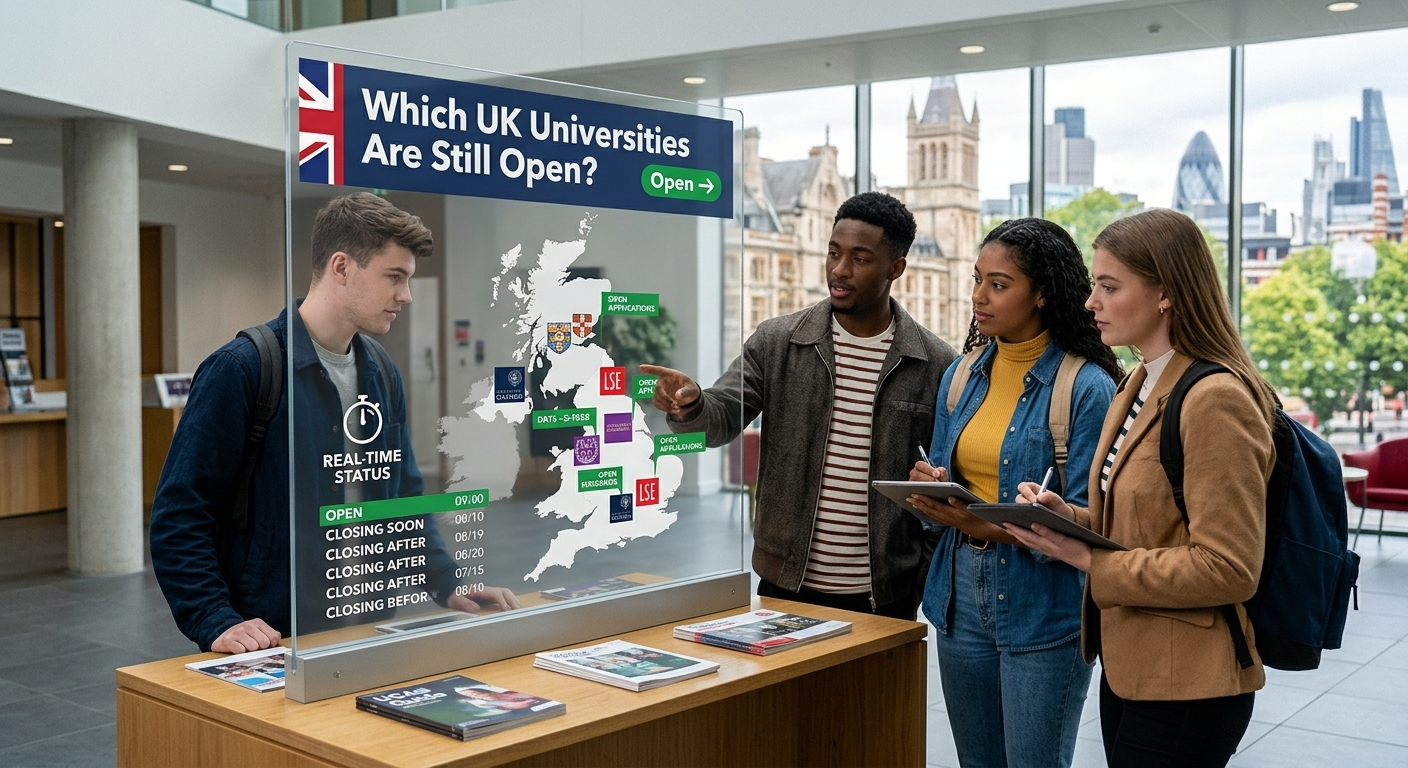
Which UK universities are still open?
There is no single national deadline. Each university sets its own, and the date can change with the course and the country you apply from. Here are published January 2027 dates for international applicants, in date order.
| University | Applications close | Notes |
|---|---|---|
| Brunel University of London | 13 November 2026 | Some courses may close sooner if places fill. |
| Cardiff Metropolitan University | 20 November 2026 | International applicants. |
| University of Liverpool | 20 November 2026 | Postgraduate courses. |
| University of East London | 27 November 2026 | Deposit and pre-CAS dates also apply on many courses. |
| University of Kent | 27 November 2026 | |
| Northumbria University | 30 November 2026 | Postgraduate courses. |
| Kingston University London | 11 December 2026 | Standard January courses. |
| University of Northampton | 14 December 2026 | Undergraduate. Postgraduate closes 4 January 2027. |
Don’t treat the closing date as your target. Many universities also set a deposit date and a CAS date, and those can come first. Missing them can leave you with an offer but no time to get a visa.
If your university isn’t in the table, that doesn’t mean it’s closed. Message us and we’ll check which of our partner universities still have January places.
What can you study in January?
January is the second main start date in the UK after September. Most of the choice is at master’s level. There are fewer undergraduate courses, but they do exist.
- Master’s degrees: the widest choice. Taught master’s courses usually take one year full-time.
- Bachelor’s degrees: a shorter list. Universities such as Middlesex, Greenwich, Coventry and Stirling offer some January starts to international students.
- Top-up degrees: if you already have an HND or a diploma, a top-up can take you to a full degree. Business, accounting and marketing are common.
- Foundation courses: availability changes from one university to the next, so ask before you assume.
The subjects that come up most often are business and management, accounting and finance, computing and IT, data science, engineering, healthcare, hospitality and tourism, and marketing.
Course lists change quickly as places fill. A course you saw last month may be full now. If you’re still choosing a subject, our guides to the top courses in the UK and foundation courses will help you narrow it down.
How to apply January Intake Uk 2027 Step By Step
With a January start this close, there is very little spare time. Here is the order that works best.
- Pick two or three courses this week. Read the entry requirements and note the closing date for each one.
- Book your English test. Some universities accept other proof of English for admission, but your visa will usually need a Home Office approved test. Test dates can fill up, so book early.
- Gather your documents. You’ll normally need your certificates and transcripts, passport, English test result, personal statement and CV. Master’s applicants are often asked for references too.
- Send your application. Most international students apply on the university’s own website. Don’t wait for the last day.
- Accept your offer and pay the deposit. The university then issues your CAS, which is the Confirmation of Acceptance for Studies. You need it for your visa.
- Apply for your visa. You’ll need your CAS, passport, proof of funds and English test result. Students from some countries also need a TB test from an approved clinic.
- Book housing and travel. Do this once your visa is approved, not before.
If you’re ready with your documents, we can prepare and submit your application for you. We do not promise offers. The university makes that decision.
Visa, English test and money
UK student visa rules got tougher in 2026. These are the points that trip people up.
- English level: since 8 January 2026, most new Student visa applicants need CEFR B2, up from B1. You prove it with a Home Office approved test (SELT). Your university may ask for a different score for admission, so check both.
- Living costs: you must show £1,529 a month for study in London or £1,171 a month elsewhere, for up to nine months. That comes to £13,761 in London or £10,539 outside it. Any tuition fee you haven’t paid yet is added on top.
- How long the money must sit there: the funds must be in your account for at least 28 days before you apply. Start early, because this alone can rule out a January visa.
- Health surcharge: the Immigration Health Surcharge is £776 for each year of your visa. Check the current visa fee on GOV.UK before you budget.
- Family members: most students can’t bring dependants. Only research-based postgraduate students and some government-funded students can.
- Timing: you can apply up to six months before your course starts. From outside the UK, decisions usually take about three weeks.
Scholarships are worth asking about too. Some universities offer them to January starters and some don’t, so put the question to each admissions team in writing.
Already living in England? You may be able to get Student Finance England for a January start. It depends on your residency status, so check on GOV.UK or let our finance adviser look at your case.
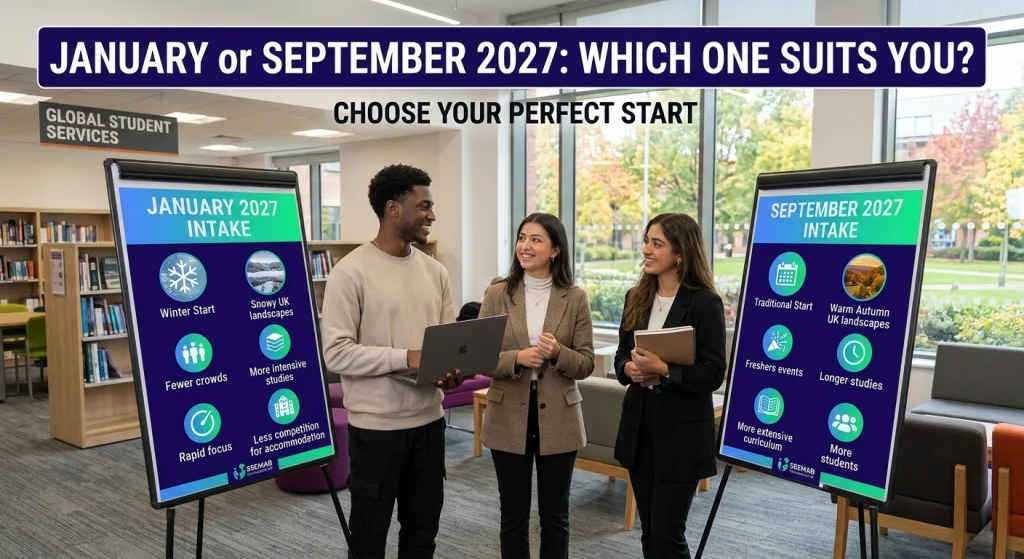
January or September 2027: which one suits you?
A rushed application is often worse than a well-prepared one that starts later. Here is a quick way to decide.
Go for January if:
- your final results and certificates are already in your hands
- you have your English test result, or a test date booked very soon
- your funds will have sat in your account for 28 days by the time you apply
- you can choose your courses within a few days
Wait for September 2027 if:
- your results aren’t out yet
- you still need to take or retake an English test
- you want a bachelor’s degree through UCAS. The main deadline for most courses is 13 January 2027 at 6pm UK time. Many universities also take international applications after that date if places are left.
- you want more time to save money or compare scholarships
Worried that your grades aren’t strong enough for either intake? Read our guide to studying in the UK with low grades.
What about Canada and other countries?
We also work with institutions in Canada, Dubai, Ireland and the United States. January looks different in each place.
Canada. Most new study permit applicants need a provincial or territorial attestation letter (PAL or TAL) before they can apply. Master’s and doctoral students at public institutions have been exempt since 1 January 2026. You also need to show CAD 22,895 for living costs outside Quebec, plus your tuition. Canada caps the number of permits it handles, and the attestation step adds time. A January 2027 start is tight for anyone who hasn’t applied yet. If Canada is your first choice, talk to us this week and we’ll tell you straight whether January is realistic or September 2027 is the safer plan.
Dubai, Ireland and the US. Intake dates and visa rules are different in each country. Ask us for the current dates before you plan around them.
Get help from Seemab Consultants in Manchester
Seemab Consultants Ltd is a UK-registered education consultancy based in Manchester. More than 400 students have enrolled at UK universities with our help.
Every Wednesday we run a free session at our office. Bring your certificates and we’ll check your eligibility on the spot. We also go through course options, Student Finance and the application process, and every student gets one-to-one time with an advisor. Sessions are limited to 30 students and run from 10:30 am to 12:30 pm. The next dates are 11, 18 and 25 November and 2 December. They focus on foundation courses, so mention January when you sit down with your advisor.
Where: Unit 110, Cariocca Business Park, 2 Sawley Road, Miles Platting, Manchester M40 8BB
Can’t come in? Message us on WhatsApp on +44 7438 678814, or email info@seemabconsultantsltd.co.uk. We’re open Monday to Friday, 10 am to 4 pm.
We don’t guarantee admission, and we won’t push a course that doesn’t suit you. If January isn’t right for you, we’ll say so.
Reserve your free spot or book a free consultation.
Frequently asked questions
Is it too late to apply for the UK January 2027 intake?
Not yet, for many courses. As of 9 November 2026, a number of universities still take applications, with closing dates from mid-November to mid-December. Some courses fill before the official date, so apply as soon as your documents are ready.
What is the deadline for the January 2027 intake in the UK?
There isn’t one single deadline. Each university sets its own. Most international deadlines fall between mid-November and mid-December 2026, and some postgraduate courses close earlier. Check the university’s own page for your course and your country.
Which UK universities have a January 2027 intake?
Many do. Brunel, Cardiff Metropolitan, Liverpool, East London, Kent, Northumbria, Kingston and Northampton have all published January 2027 dates. Course lists differ, so ask us to check which ones still have places in your subject.
Can I start a bachelor’s degree in the UK in January?
Yes, at some universities, but the choice is smaller than in September. Most January places are at master’s level. Top-up degrees and some foundation courses also start in January.
What English level do I need for a UK student visa in 2026?
Most new applicants need CEFR B2, proved with a Home Office approved test (SELT). That rule began on 8 January 2026. Your university may ask for a different score for admission.
How much money do I need to show for a UK student visa?
For up to nine months of living costs, you need £1,529 a month in London (£13,761 in total) or £1,171 a month elsewhere (£10,539). Add any tuition fee you haven’t paid yet. The money must be in your account for at least 28 days.
Can I get Student Finance for a January start?
Possibly, if you live in England and meet the residency rules. Check GOV.UK or ask our finance adviser at a Wednesday session. Most international students on a Student visa don’t qualify.